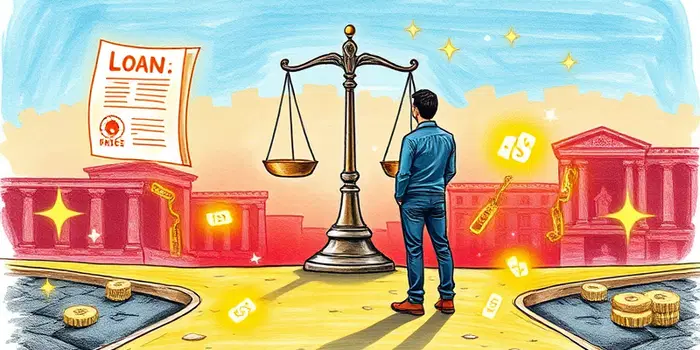
Debt is neither inherently good nor bad—it is a tool that can empower or encumber depending on how it is evaluated and managed. Understanding that borrowing involves emotional considerations as well as financial ones is the first step toward making smart loan decisions.
In the United States, household debt reached approximately $18.8 trillion in the second quarter of 2026, a 32% increase since 2019, according to the Federal Reserve Bank of New York. About 4.7% of that debt was in some stage of delinquency. While data from Equifax reported consumer debt of $18.19 trillion in Q1 2026 and a 17.01% 90-plus-day delinquency rate on student loans, methodological differences underscore the need to compare like with like. These figures highlight the magnitude of borrowing, but numbers alone do not explain why people take on loans or how they can make better choices.
Why Do People Borrow Despite Future Stress?
At its core, borrowing satisfies an immediate need or desire. Whether financing education, housing, transportation, or an emergency, loans can deliver relief when cash flow is tight. Yet many borrowers underestimate the full cost, driven by the allure of instant gratification and a focus on monthly payments rather than total repayment.
Present bias causes individuals to overvalue immediate benefits—receiving $10,000 today feels more urgent than a $350 monthly payment stretched over years. When stress mounts, financial scarcity narrows attention toward urgent needs, making expensive credit appear as the only solution. Emergencies—medical bills, rent arrears, or car repairs—create powerful incentives to borrow without fully weighing long-term effects.
Psychological Biases That Lead to Poor Loan Decisions
Behavioral psychology reveals that loans are not assessed solely on interest rates or terms. Instead, multiple biases distort perception:
- Optimism bias—Believing future income will rise and emergencies won’t happen.
- Anchoring—Focusing on a low advertised payment or introductory rate instead of total cost.
- Mental accounting—Treating different debts as separate buckets instead of a unified budget impact.
- Overconfidence—Assuming spending discipline and income stability will last indefinitely.
- Framing effects—Responding to “$0 down” or “0% interest” labels without parsing fees or deferred interest.
Each of these biases can be subtle yet powerful, leading a borrower to accept terms that feel manageable in the moment but can spiral into financial stress.
How Debt Affects Cognition, Emotions, and Future Choices
Carrying debt is more than a line on a balance sheet. Research links financial obligations to cognitive impairment: one study found that paying off a debt account improved cognitive functioning by a quarter of a standard deviation and reduced anxiety by 11%.
High debt levels can cause:
- Reduced concentration and decision-making ability under stress.
- Sleep disruption and persistent worry about payments.
- Shame leading to avoidance of bills and lender communication.
- Short-term decision-making that sacrifices future stability.
These effects create a feedback loop: stress impairs judgment, which can lead to missed payments, added fees, and deeper anxiety.
A Practical Process for Smart Loan Decisions
To break the cycle and make informed choices, consumers can follow a structured evaluation:
- Convert offers into comparable figures: Calculate the annual percentage rate, total finance charge, and total amount repaid.
- Test affordability under conservative scenarios: Assume income remains flat or dips by 10% and include potential fees or rate increases.
- Assess against total cash flow: Add new payment obligations to existing debt service to confirm capacity.
- Compare multiple lenders: Look beyond promotional rates to sample full quotes and hidden fees.
- Factor in non-financial impacts: Consider potential stress, cognitive distraction, and household dynamics.
By converting every loan into its true cost and stress impact, borrowers can neutralize anchoring and framing biases.
Consumer-Protection Guidance and Resources
Borrowers should know their rights and seek help when needed:
1. Review the Truth in Lending Act disclosures to confirm APR, fees, and penalties. Lenders must provide clear, standardized information before closing.
2. Use reputable online calculators from nonprofit credit counselors to model repayment under worst-case scenarios.
3. Contact a housing or student-loan counselor if facing hardship. Federal regulations often allow temporary forbearance or income-driven plans without damaging credit.
Delinquency Rates by Loan Type (Q2 2026)
Note: New York Fed and Equifax numbers vary due to different definitions, samples, and reporting periods. Always check methodology when comparing data.
Building Resilience and Long-Term Financial Health
Smart borrowing balances opportunity with caution. Debt can unlock vital resources for housing, education, or emergencies. By recognizing the influence of psychological biases and adopting a disciplined evaluation process, consumers can avoid cognitive pitfalls and stress traps.
Early communication with lenders, proactive use of consumer protections, and transparent comparison of offers protect both mental well-being and financial stability. In a landscape where household debt surpasses $18 trillion, making thoughtful, unbiased loan decisions is not just prudent—it is essential for lasting prosperity.
References
- https://www.newyorkfed.org/newsevents/news/research/2026/20260811
- https://www.newyorkfed.org/newsevents/news/research/2026/20260512
- https://www.newyorkfed.org/newsevents/news/research/2026/20260210
- https://www.newyorkfed.org/microeconomics/hhdc/background.html
- https://www.newyorkfed.org/medialibrary/interactives/householdcredit/data/pdf/HHDC_2026Q2
- https://kpmg.com/us/en/articles/2026/q1-2026-hhdacr.html
- https://www.reuters.com/markets/wealth/us-household-credit-troubles-worsened-end-2025-new-york-fed-says-2026-02-10/
- https://www.newyorkfed.org/newsevents/news/research/2025/20251105
- https://www.debt.org/faqs/americans-in-debt/demographics/
- https://investor.equifax.com/news-events/press-releases/detail/1394/equifax-national-market-pulse-data-shows-u-s-consumer-debt
- https://investor.equifax.com/news-events/press-releases/detail/1409/u-s-consumer-debt-hits-18-19-trillion-in-q1-2026
- https://finance.yahoo.com/personal-finance/banking/article/household-debt-edges-up-to-new-high-but-credit-card-balances-dip-183325142.html
- https://www.federalreserve.gov/econres/notes/feds-notes/a-note-on-recent-dynamics-of-consumer-delinquency-rates-20251124.html
- https://pmc.ncbi.nlm.nih.gov/articles/PMC6462060/