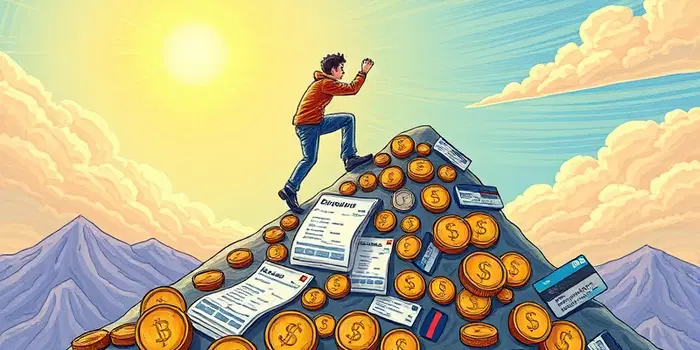
Carrying debt can feel like an uphill climb, but with a clear strategy and consistent action, you can reach the summit of financial freedom. This guide walks you through proven methods to reduce balances, cut interest costs, and build lasting momentum.
From credit cards to mortgages, understanding how much to pay, where to focus extra dollars, and how to protect your essential goals will transform scattered borrowing into a targeted payoff plan.
Why a Repayment Strategy Matters
In the second quarter of 2026, U.S. households held roughly $18.8 trillion in total debt, with 4.7% of balances in some stage of delinquency. Credit-card debt rose by 1.7%, and serious delinquency surpassed 12.9%. Student loans alone reached $1.65 trillion, with over 10.6% of balances at least 90 days overdue. These figures underscore the urgent need for deliberate debt repayment planning.
Missed payments not only drive up your interest costs but can damage your credit score, making future borrowing more expensive. A structured approach shields you from slipping behind and empowers you to regain control.
Essential Terms Defined
Before diving into strategies, clarify the language of borrowing:
- Principal: The remaining balance before interest and fees.
- APR (Annual Percentage Rate): The yearly cost of borrowing, including fees.
- Minimum Payment: The smallest payment required to stay current.
- Amortization: The schedule that allocates each payment between principal and interest.
- Debt-to-Income Ratio: Monthly debt payments divided by gross income, expressed as a percentage.
- Delinquency: A payment that is overdue; extended delinquency can lead to default.
Build a Complete Debt Inventory
Start by listing every outstanding obligation in a comprehensive debt inventory table. Gathering statements ensures you work with accurate numbers rather than estimates.
Include every type of debt: credit cards, personal and auto loans, student loans, medical bills, buy-now-pay-later accounts, home-equity lines, mortgages, tax liabilities, and any formal loans from friends or family.
Craft a Realistic Cash-Flow Plan
Your payoff strategy must be sustainable. Allocate each dollar thoughtfully to essentials, savings, and debt.
- Housing and Utilities
- Food and Essential Transportation
- Insurance and Healthcare
- Required Taxes
- Minimum Debt Payments
- A Modest Emergency Reserve
- Additional Payment Toward Target Debt
- Optional Spending and Accelerated Savings
A small cushion of sustainable emergency cash reserve prevents unexpected expenses from derailing progress. Then calculate your extra debt payment as:
Net Income – Essential Expenses – Minimum Payments – Planned Savings
For irregular earners, commit to a fixed base payment and allocate a percentage of bonuses or windfalls toward debt—while reserving funds for taxes and contingencies.
Debt Avalanche Method
The mathematically efficient avalanche method targets the highest-interest debt first. You continue paying minimums on all accounts, directing extra funds to the costliest APR.
- List debts from highest APR to lowest APR.
- Pay the minimum on every account.
- Apply all additional money to the highest-rate debt.
- Once paid off, roll its payment into the next-highest rate balance.
- Repeat until every debt is eliminated.
This approach usually yields the shortest possible payoff period and minimizes total interest. However, paying down a large high-rate balance first can feel slow, and it requires strict discipline.
Example: A borrower owes $2,000 at 29% APR, $6,000 at 22% APR, and $8,000 at 11% APR. The avalanche order is straightforward—tackle the 29% balance first, then move to the 22% account, and finish with the personal loan.
Debt Snowball Method
The snowball method builds psychologically sustaining small payment victories. You focus extra dollars on the smallest balance, regardless of interest rate, while making minimum payments on all other accounts.
By celebrating early wins—eliminating the tiniest debts—you often gain motivation to continue. This method can be more engaging for those who struggle with long-term discipline, though it may cost more interest overall.
Example: If that same borrower’s smallest balance is the $2,000 card, paying it off first gives immediate satisfaction. Then you channel those freed-up payments to the next-smallest balance, and so on.
Refinancing, Consolidation, and Cautions
Options like balance transfers, loan consolidation, and refinancing can lower interest rates or simplify payments. Yet each carries eligibility requirements, fees, and potential risks:
• Balance transfers may impose transfer fees and expire promotional rates.
• Refinancing student or auto loans can extend terms and widen total interest.
• Consolidation might mix secured and unsecured debt, affecting collateral risk.
Above all, avoid missing payments. Even a single late fee can trigger higher APRs and damage your credit. Start your repayment plan before delinquency to lock in lower rates and maintain a strong credit profile.
By combining a comprehensive debt repayment plan, disciplined budgeting, and the avalanche or snowball strategy that suits your personality, you can accelerate the path to financial freedom. Take control now—each payment brings you one step closer to a life unburdened by debt.
References
- https://www.newyorkfed.org/newsevents/news/research/2026/20260811
- https://www.newyorkfed.org/medialibrary/interactives/householdcredit/data/pdf/HHDC_2026Q2
- https://www.newyorkfed.org/newsevents/news/research/2026/20260512
- https://www.newyorkfed.org/medialibrary/interactives/householdcredit/data/pdf/HHDC_2026Q1
- https://www.newyorkfed.org/householdcredit/hhdc-iframe
- https://www.newyorkfed.org/newsevents/news/research/2026/20260210
- https://libertystreeteconomics.newyorkfed.org/2026/08/how-distressed-are-consumers-reconciling-diverging-credit-card-delinquency-measures/
- https://www.newyorkfed.org/microeconomics/hhdc/background.html
- https://kpmg.com/us/en/articles/2026/q2-2026-hhdacr.html
- https://kpmg.com/us/en/articles/2026/q1-2026-hhdacr.html
- https://www.newyorkfed.org/microeconomics/hhdc
- https://www.newyorkfed.org/microeconomics/databank.html
- https://abcnews.com/US/credit-card-debt-rises-126-trillion-nearing-time/story?id=135556533
- https://www.newyorkfed.org/newsevents/mediaadvisory/2026/0804-2026
- https://libertystreeteconomics.newyorkfed.org/2026/05/federal-student-loan-defaults-return-after-pandemic-pause/